Topological Quantum Computing
Scientific Question & Motivation
Topological quantum computing (TQC) protects quantum information non-locally inside degenerate fusion spaces of non-abelian anyons, implementing fault-tolerant gates via braid group representations that are immune to local perturbations. Fibonacci anyons (\(\tau \times \tau = \mathbf{1} \oplus \tau\)) are universal for quantum computation by braiding alone, yet engineering and controlling physical non-abelian quasiparticles remains experimentally demanding.
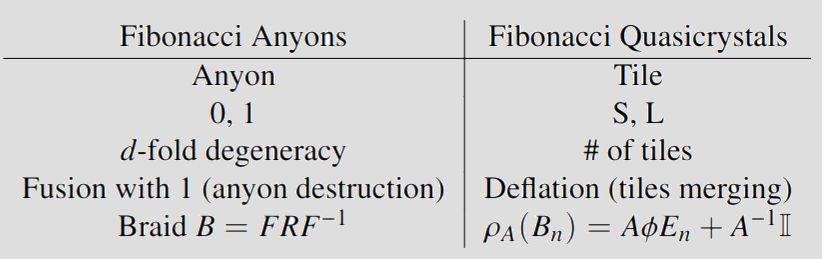
Our research explores an alternative algebraic and geometric bridge: aperiodic topological quantum computing, exploiting the mathematical isomorphism between the fusion Hilbert spaces of Fibonacci anyons and the constrained tiling spaces of 1D and 2D Fibonacci quasicrystals (Amaral et al. 2022; Marcelo M. Amaral 2025), alongside topological qubits derived from 3-manifold fundamental groups, Fricke character varieties, and magic-state geometries (Planat et al. 2018, 2019, 2022).
Core Algebraic Mechanism
A 1D Fibonacci quasicrystal word over \(\{0, 1\}\) generated by the substitution rule \(1 \mapsto 10\), \(0 \mapsto 1\) forbids adjacent zeros (00). On an \(n\)-qubit chain, the constrained subspace
\[ \mathcal{H}_{\mathrm{Fib}}^{(n)} = \operatorname{span}\bigl\{\, |x_1 x_2 \dots x_n\rangle \in (\mathbb{C}^2)^{\otimes n} \;\big|\; x_i x_{i+1} \neq 00 \text{ for all } i \,\bigr\} \]
has dimension \(\dim \mathcal{H}_{\mathrm{Fib}}^{(n)} = F_{n+2}\), matching the fusion-tree multiplicity of Fibonacci anyons. Temperley–Lieb projectors \(E_i\) with loop fugacity \(d = \varphi = \frac{1+\sqrt{5}}{2}\) satisfying
\[ E_i^2 = d\, E_i, \qquad E_i E_{i\pm 1} E_i = E_i, \qquad [E_i, E_j] = 0 \quad (|i-j| \ge 2) \]
yield unitary Jones–Wenzl / braid representations \(B_i = A\, \mathbf{1} + A^{-1} E_i\) (\(A = e^{3\pi i/5}\)) that can be compiled and benchmarked directly on gate-based qubit simulators and hardware (Marcelo M. Amaral 2025).
Fibonacci Forbidden-Word Hamiltonians
The preprint A Hierarchy of Fibonacci Forbidden-Word Hamiltonians extends the constrained-word approach from the golden chain through the plastic chain toward aperiodic Fibonacci order (Marcelo Maciel Amaral 2025). It studies how progressively excluding longer forbidden patterns reduces the growth rate of the ground-state language. The plastic chain (\(K=4\)) forbids SS and LLL.
Within this construction, the paper identifies exact Temperley–Lieb braiding compatibility at the base rung (\(K=3\)); higher rungs describe constrained aperiodic Hamiltonian codes. This distinction connects the hierarchy to the QIC braid framework while keeping the scope of the higher-rung models explicit.
Living Projects & Open-Source Code
- Quasicrystal Inflation Code (QIC) — Full theoretical formulation (
arXiv:2506.21643), detailed research article, and MIT-licensed Python package (quasicrystal-inflation-code). - GaugeBench — Verifiable quantum benchmarking wrapping gate-based (QIC) and annealing engines with Content-Addressable Receipts (
gaugebench).
Selected Publications
- A Hierarchy of Fibonacci Forbidden-Word Hamiltonians: From the Golden Chain to the Plastic Chain and Aperiodic Order — Marcelo Maciel Amaral (preprint, November 9, 2025). DOI · PDF.
- Consistent Simulation of Fibonacci Anyon Braiding within a Qubit Quasicrystal Inflation Code — M. M. Amaral (arXiv:2506.21643, 2025).
- Exploiting Anyonic Behavior of Quasicrystals for Topological Quantum Computing — M. Amaral, D. Chester, F. Fang, K. Irwin (Symmetry 14(9), 1780, 2022).
- Fricke Topological Qubits — M. Planat, D. Chester, M. M. Amaral, K. Irwin (Quantum Reports 4(4), 523–532, 2022).
- Character Varieties and Algebraic Surfaces for the Topology of Quantum Computing — M. Planat, M. M. Amaral et al. (Symmetry 14(5), 915, 2022).
- Group Geometrical Axioms for Magic States of Quantum Computing — M. Planat, R. Aschheim, M. M. Amaral, K. Irwin (Mathematics 7(10), 948, 2019).
- Universal Quantum Computing and Three-Manifolds — M. Planat, R. Aschheim, M. M. Amaral, K. Irwin (Symmetry 10(12), 773, 2018).