Consistent Simulation of Fibonacci Anyon Braiding within a Qubit Quasicrystal Inflation Code
Structured Research Article & Open-Source Algebraic Engine
Abstract
Fibonacci anyons provide a dense, universal gate set for fault-tolerant topological quantum computation through braiding alone, yet direct hardware realization of non-abelian anyonic quasiparticles remains challenging. Building upon the correspondence between Fibonacci anyon fusion trees and 1D/2D Fibonacci quasicrystal tiling spaces (Amaral, Chester, et al. 2022), the Quasicrystal Inflation Code (QIC) embeds Fibonacci fusion subspaces isometrically inside standard 1D qubit chains subject to the local golden-mean constraint forbidding adjacent 00 bit pairs (Amaral 2025a). Within this constrained subspace, local Temperley–Lieb projectors and \(F\)/\(R\)-move braid generators satisfy exact algebraic coherence, unitarity, and Artin braid relations, enabling transparent simulation and hardware benchmarking on gate-based quantum processors.
1. Physical & Mathematical Motivation
In the \(\mathrm{SU}(2)_3\) (integer-spin Fibonacci) modular tensor category, there is a single nontrivial topological charge \(\tau\) alongside the vacuum \(\mathbf{1}\), governed by the non-abelian fusion rule
\[ \tau \otimes \tau = \mathbf{1} \oplus \tau, \qquad \mathbf{1} \otimes \tau = \tau \otimes \mathbf{1} = \tau. \tag{1}\]
Remarkably, the exact same combinatorial recurrence governs 1D Fibonacci substitution words (\(1 \mapsto 10\), \(0 \mapsto 1\)) and cut-and-project Fibonacci quasicrystals (Amaral et al. 2021; Amaral, Aschheim, et al. 2022; Amaral, Chester, et al. 2022).
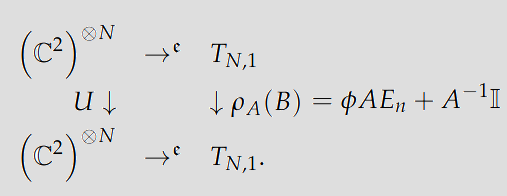
2. Constrained Hilbert Space & Inflation Isometry
Definition 1 (Golden-Mean Qubit Subspace) For an \(n\)-qubit register \((\mathbb{C}^2)^{\otimes n}\), define the constrained Fibonacci subspace \(\mathcal{F}_n\) spanned by computational basis bitstrings with no adjacent zeros:
\[ \mathcal{F}_n = \operatorname{span}\Bigl\{\, |x_1 x_2 \dots x_n\rangle \in (\mathbb{C}^2)^{\otimes n} \;\Big|\; x_i \in \{0,1\},\; (x_i, x_{i+1}) \neq (0,0) \;\forall\, 1 \le i < n \,\Bigr\}. \tag{2}\]
Let \(\varphi = \frac{1+\sqrt{5}}{2}\) denote the golden ratio (\(\varphi^2 = \varphi + 1\)). Enforcing \((x_i, x_{i+1}) \neq (0,0)\) via the local penalty Hamiltonian
\[ H_{\mathrm{cons}} = \Delta \sum_{i=1}^{n-1} |00\rangle\langle 00|_{i,i+1} \qquad (\Delta > 0) \]
identifies \(\mathcal{F}_n = \ker H_{\mathrm{cons}}\) as the zero-energy ground-state manifold.
| Qubits \(n\) | Allowed Basis Strings in \(\mathcal{F}_n\) | \(\dim \mathcal{F}_n = F_{n+2}\) | Full Register \(2^n\) |
|---|---|---|---|
| 1 | 0, 1 |
2 | 2 |
| 2 | 01, 10, 11 |
3 | 4 |
| 3 | 010, 011, 101, 110, 111 |
5 | 8 |
| 4 | 0101, 0110, 0111, 1010, 1011, 1101, 1110, 1111 |
8 | 16 |
| 5 | 13 golden-mean bitstrings | 13 | 32 |
3. Temperley–Lieb Projectors & Unitary Braid Gates
On the two-dimensional fusion channel \(\tau \otimes \tau \otimes \tau \to \tau\) (represented locally by three-site configurations \(|101\rangle \leftrightarrow |\mathbf{1}\rangle\) and \(|111\rangle \leftrightarrow |\tau\rangle\) bounded by 1s), basis change between fusion orderings is governed by the real symmetric unitary \(F\)-matrix:
\[ F = \begin{pmatrix} \varphi^{-1} & \varphi^{-1/2} \\ \varphi^{-1/2} & -\varphi^{-1} \end{pmatrix}, \qquad F^\dagger F = F^2 = I_2, \tag{3}\]
where \(\varphi^{-2} + \varphi^{-1} = 1\) guarantees exact unitarity. Together with the diagonal topological twist phases \(R = \operatorname{diag}(e^{-4\pi i/5},\, e^{3\pi i/5})\), local Temperley–Lieb generators \(E_i\) of loop fugacity \(d = \varphi\) satisfy:
Theorem 1 (Temperley–Lieb & Artin Braid Consistency) On \(\mathcal{F}_n\), the local projection operators \(\{E_i\}\) and elementary braid operators \(\sigma_i = e^{3\pi i/5} I + e^{-3\pi i/5} E_i = e^{3\pi i/5} I + \bigl(e^{-4\pi i/5} - e^{3\pi i/5}\bigr) \varphi^{-1} E_i\) satisfy:
- Temperley–Lieb relations: \(E_i^2 = \varphi E_i\), \(E_i E_{i\pm 1} E_i = E_i\), and \([E_i, E_j] = 0\) for \(|i-j| \ge 2\).
- Subspace closure & unitarity: \([\sigma_i, H_{\mathrm{cons}}] = 0\) and \(\sigma_i^\dagger \sigma_i = I_{\mathcal{F}_n}\).
- Artin braid group relation: \(\sigma_i \sigma_{i+1} \sigma_i = \sigma_{i+1} \sigma_i \sigma_{i+1}\).
4. Open-Source Implementation & Reproducibility
The companion MIT-licensed Python package quasicrystal-inflation-code (Amaral 2025b) provides deterministic verification of every algebraic identity above:
import numpy as np

phi = (1.0 + np.sqrt(5.0)) / 2.0
F = np.array([[1.0 / phi, 1.0 / np.sqrt(phi)],
              [1.0 / np.sqrt(phi), -1.0 / phi]])
R = np.diag([np.exp(-4j * np.pi / 5.0), np.exp(3j * np.pi / 5.0)])
B = F @ R @ F

assert np.allclose(F @ F, np.eye(2))
assert np.allclose(B.conj().T @ B, np.eye(2))
In src/qic_core.py, multi-qubit chains \(\mathcal{F}_n\), inflation isometries \(V: \mathcal{F}_n \hookrightarrow \mathcal{F}_{n+1}\), Temperley–Lieb operators \(E_i\), and multi-strand braid circuits are constructed and unit-tested, and exposed to hardware/simulator benchmark suites via GaugeBench (Amaral 2026).
References
Citation
@misc{m._amaral2025,
  author = {M. Amaral, Marcelo},
  title = {Consistent {Simulation} of {Fibonacci} {Anyon} {Braiding}
    Within a {Qubit} {Quasicrystal} {Inflation} {Code}},
  date = {2025-06-25},
  url = {https://arxiv.org/abs/2506.21643},
  doi = {10.48550/arXiv.2506.21643},
  langid = {en}
}